Fall 2022
How Writers Read
  • Syllabus
    • Course Purpose
    • Course Policies
  • Schedule
  • Assignments
    • Required Readings >
      • Iron Hans
      • Hesse
      • McKee
      • Gallop
      • Silverman
      • Butler
      • Mamet
      • Porter
      • Campbell
      • Seitz
      • Rabinowitz
      • Phelan
      • Culler
      • Jensen
    • Inventory and Reflection
    • Reading List Proposal >
      • Recommended Texts
    • Readings
    • Final Reflection
  • Methods
    • Reading For
    • Register
    • Graphing Narrative Structure
    • Summarizing Narratives
    • Close-Reading and Genre >
      • Value Graph
      • Getting the Text
      • Tropes and Figures
    • Intertextual Codes >
      • Controlling Value >
        • Writing out Controlling Values
    • Rhetoric of Narrative >
      • Distinguishing Character
  • Scribbles

Register

​One important quality of writing we are working to distinguish is something called "register," and the varieties of register in writing and/or reading. Register is a term used in musicology to mean a range of notes possible for an instrument to play, except that here we are looking at register within language use, and especially within performances of writing and reading. For instance, the spectrum from the concrete to the abstract and all steps in between would constitute an "octave," and so would other registers that constantly are at play as ways of "reading for" that we bring into any reading situation.
I suggest that the practice of distinguishing register at work in a given text would also allow us to distinguish how we project and perform with a particular register whenever we read or listen, and of course, when we write. Once you can distinguish registers, then you can "hear" or "see" them in actual texts. In fact, you might even consider that registers do not exist per se except in those moments when we distinguish them. You can't catch what you can't see, and you can't write what you can't read.
Picture
In How Writers Read, we begin with three terms that imply an understanding of register: the mimetic, the thematic, and the synthetic. Below is a more elaborate exploration of register that includes these three terms while also moving beyond them to also indicate what registers you will be dealing with for each reading.
I have adapted the following four registers (ranges) of language use from Tzvetan Todorov's Introduction to Poetics, pages 21-26:

Reading One
The first register is “concrete versus/and abstract” language. At one end of the spectrum of this register, concrete language use calls for very precise particularities. At the other end of the spectrum we find wide generalities that often lack any real content.
Concrete language often serves to imitate what the audience expects to be "real," otherwise known as the "mimetic" register. Mimesis is that quality of narrative that appears to duplicate, or represent "reality" as we experience it in everyday life, such that the audience may suspend disbelief and enter the narrative world as if it is real, which furthermore permits various degrees of investment in the characters pursuing desire in conflict with others in a "world."
Abstract language evokes responses to the thematic dimension of the narrative, which may include issues that are ethical, cultural, social, political, philosophical, etc. This may also be understood as "diegesis," when the reader understands the narrator or writer speaking and interpreting, telling the story rather than allowing the scene to show us the story.
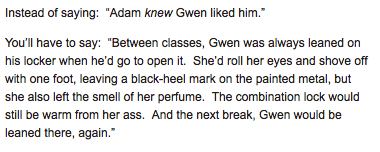
Undeveloped narratives often rely too heavily on abstract language, or diegetic exposition, rather than allowing the mimetic effect of concrete language, otherwise known as writing "in-scene," to do its work. Chuck Palahniuk provides excellent instruction for writers wishing to shift their dominant "abstract" register to the "concrete" in this short essay. However, writing that is highly reflective employs the thematic effectively. In other words, there is always a time and place to write in any given register. 

Picture
Picture

Reading Two
The second register is “figural versus/and transparent” language. This is where we begin to shift from purely concrete or thematic language, which is transparent either to the "things-themselves," or to the "thoughts themselves"--the main idea--and pivot to figural, that is, synthetic language, which draws attention to itself, often through the presence of rhetorical figures of speech and thought, tropes and schemes--tropes such as metaphor, metonymy, irony, etc. and schemes such as anaphora, antimetabole, antithesis, prosopopoeia, zeugma, etc. These are elements that draw attention to themselves and so draw audiences more interested in the "art" at work in the text, which reveals its synthetic, artificial constructedness.
Please use this document to help yourself become acquainted with rhetorical figures of speech and thought that will help you to explore the surprising details in the language itself, which will in turn help you to notice and challenge the projections that remain hidden as long as you are beholden to the transparent register of language.
2b_1_rutilian_figures.doc
File Size: 288 kb
File Type: doc
Download File

Another way to approach this register is to see it as expressing the spectrum called "fragmentary versus/and integral" writing, or the different versus/and the similar.
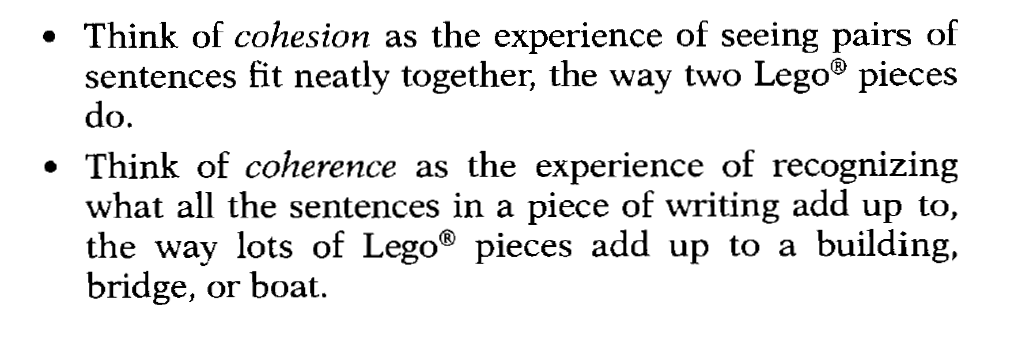
​One issue to explore here is the degree to which the writing possesses explicit or implicit cohesion and coherence (see Williams' book Style, Lesson 5).
Picture
williams_lesson5.pdf
File Size: 102 kb
File Type: pdf
Download File

Here is an example that will provide an illustration for the explanation that follows. As you read the following very fragmentary text, notice that it explicitly lacks both cohesion and coherence:
"A newspaper is better than a magazine.  A seashore is a better place than a street.  At first it is better to run than to walk.  You may have to try several times.  It takes some skill, but it is easy to learn.  Even young children can enjoy it.  Once successful, complications are minimal.  Birds seldom get too close.  Rain, however, soaks in very fast.  Too many people doing the same thing can also cause problems.  One needs lots of room.  If there are no complications it can be very peaceful.  A rock will serve as an anchor.  If things break loose from it, however, you will not get a second chance.”

​Burton. On Being Certain:  Believing You Are Right Even When You Are Not. St. Martin’s Press, New York, NY 2008
The more fragmentary the text, such as is given by this example, the more the text possesses implicit cohesion and coherence. At this end of the register, the reader must supply the background context in order to articulate meaning and bring integrity to a given fragmentary text. For instance, go back and re-read the passage again with the following implicit background context called "kite."

On the other hand, the more integral the text, the more the text possesses explicit cohesion and coherence. At this end of the register, the text seems to supply the background context, allowing the reader to grasp the integrity of a given piece of writing.

This register easily overlaps with other registers, for instance, "monovalency versus polyvalency." The more monovalent the text is, the more integral the text would appear to be, the more singular and obvious the meaning of the text is, and so the less demand on the reader to bring coherence to the text. However, the more fragmentary the text the more likely the background context (what unites the fragments) will be missing, or will seem to exist outside the text: hence the more the text is polyvalent, open to multiple, even contradictory interpretations.

​Reading Three
The third register is “monovalency versus/and polyvalency” in language use.
Valency is any reference to texts or ideas outside the text you are writing. Monovalency involves little reference outside the text, and polyvalency involves several--if not a multitude of--references. Monovalency does not require as much work on the part of the reader, but polyvalency does, as it asks that the reader be familiar with all the hints and references to various items, conventions, practices, understandings, assumptions, etc., not explicitly mentioned. For instance, “parody” involves polyvalency as it calls upon the reader to be familiar with what is being parodied to get the joke.
The polyvalent register comes alive for the reader once the reader has begun to explore the "traces" both iterated and presupposed in a given text (see James Porter's "Intertextuality and the Discourse Community"). The role a reader must play to experience the polyvalent register is what Peter Rabinowitz calls the "authorial audience," the audience the implied author addresses (see "Truth in Fiction"). See the lecture on "intertextuality."

Reading Four
The fourth and last register (for Todorov) is the "degree of subjectivity" (or to keep things parallel, subjectivity versus/and objectivity) present within the language, which calls for attending to the rhetorical dimension of narrative, namely, attending to the fact that a narrator, for some purpose, addresses one or more audiences.
Essential to operating with this register is distinguishing the rhetoric of narrative, which includes distinguishing the narrator from the implied author, and the various audience roles, from the submissive to the resistant, from the authorial audience who the implied author expects to get everything the way it was intended, to the narrative audience who takes the narrative to be true, to the ideal narrative audience who takes unreliable narration as true, to the actual audience, the flesh and blood individual who may or may not be capable of exercising one or all of these possible roles (see Seitz, Rabinowitz, and Phelan).

Keep in mind that when you write or evaluate writing, any position along the range of a given register has its value while at the same time poses a problem. It is important to examine both aspects of each register in a given piece of writing.
Powered by Create your own unique website with customizable templates.